
Meet the Manager
Who runs Stevens Square Locksmith, how he came to the trade, and the lock work he finds most interesting.
Eric Allen
Owner and manager of Stevens Square Locksmith since 2007, and the locksmith who drives out to the job
Eric started the company because he wanted to deal directly with the people whose doors he was fixing. It still runs that way: the person who comes to look at the lock is the person who owns the business.
His work centers on Stevens Square and reaches across Minneapolis. Photographs from the company’s jobs are gathered under Our Work.
My first job was cutting keys at a hardware store, and I liked how quickly a small problem got solved.
The work I find most interesting is old mortise locks and stubborn lockouts around Minneapolis, since each needs some figuring out before anything gets drilled or replaced. Rekeying after tenants move out is a close second. Most days the work is a quiet fix for someone having a bad afternoon.
Eric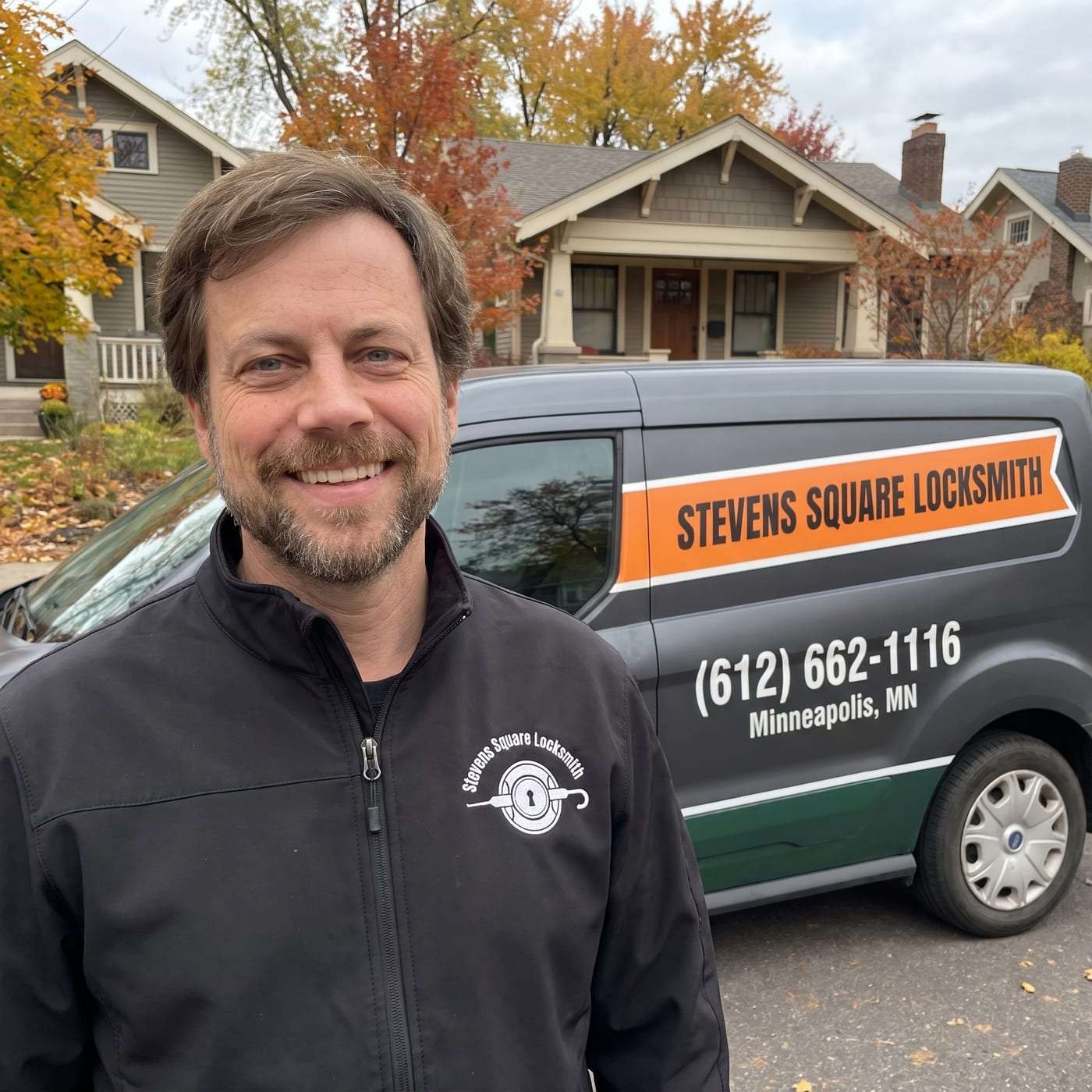
A Call in Plain Words
Lock trouble seldom picks a good moment: a key snapped in the cylinder on the way out, a deadbolt that will not turn with the groceries still in hand, a car shut with the fob on the seat.
Calling about it takes no lock vocabulary. The first questions are plain ones: where you are, what the lock or door is doing, and whether anyone is locked out.
Everyday words carry most of what a locksmith needs. “The key turns but the bolt stays out” points to the cam, the tailpiece or a bolt binding in its strike. “The key will not go in” points to something in the keyway, ice included. “The handle just spins” points to the spindle or the parts it should be turning inside the lock.
How the rest of a visit runs, from the address to the work at the door, is set out under Our Approach.
Old Mortise Locks
An old mortise lock keeps its works in a flat steel box let into the edge of the door: the latch, often a deadbolt, the springs, and the small levers that link them to the knob and the key. The cylinder screws into the face of the box, and a set screw behind the faceplate on the door edge stops it from turning.
Many older apartment buildings and houses still have them. The difficulty with an old one is that everything happens out of sight. A spring tired after decades, a cracked hub, a worn cam or a cylinder that has backed out a turn can all look alike from outside: a knob that turns while the latch stays put, or a key that turns and moves nothing.
Finding out which one it is means taking the case out of the door and opening it. From there the choice usually runs between a repair inside the old case, a modern mortise case made to fit the same pocket, and converting the door to a cylindrical lock, which means filling the pocket and boring new holes and is the most work of the three. Many old cases are long out of production, so a matching part is not always there to be had.
Stubborn Lockouts
A door held only by its spring latch is usually the simpler kind of lockout. The stubborn ones start harder: a deadbolt thrown behind a cylinder built to resist picking, a key that snapped mid-turn and left the plug off center, a mortise lock with its bolt out, or a door that has shifted until the bolt is pinched in its strike.
The figuring out starts with reading the door. Which lock is actually holding it, which way the door swings, what the frame is made of and how much gap there is at the edge: each answer changes the order of the work. Picking and bypass tools come first where the lock allows them, and drilling comes last, because the cylinder it goes through has to be replaced afterward.
A lockout happening now is a phone call: (612) 662-1116.
Rekeying for a New Tenant
Rekeying between tenants is quieter work than a lockout, with a puzzle of its own. The aim is plain: once it is done, the new tenant’s key opens the unit and no earlier key does, whoever kept a copy.
A unit door often carries two keyed locks, a knob or lever and a deadbolt, and both are usually rekeyed to one new key. In a building on a master key system, the new pins also have to leave the master working, and each unit’s key has to stay different from every other unit’s, so the building’s keying chart matters as much as the cylinder in hand.
A landlord turning over a unit can send the address, the unit number and the locks on its door through Schedule an Estimate.