
Business Locks in Minneapolis
Locks, keys and exit hardware for shops, offices and small buildings, where a door has to lock from outside and still open from inside without a key.
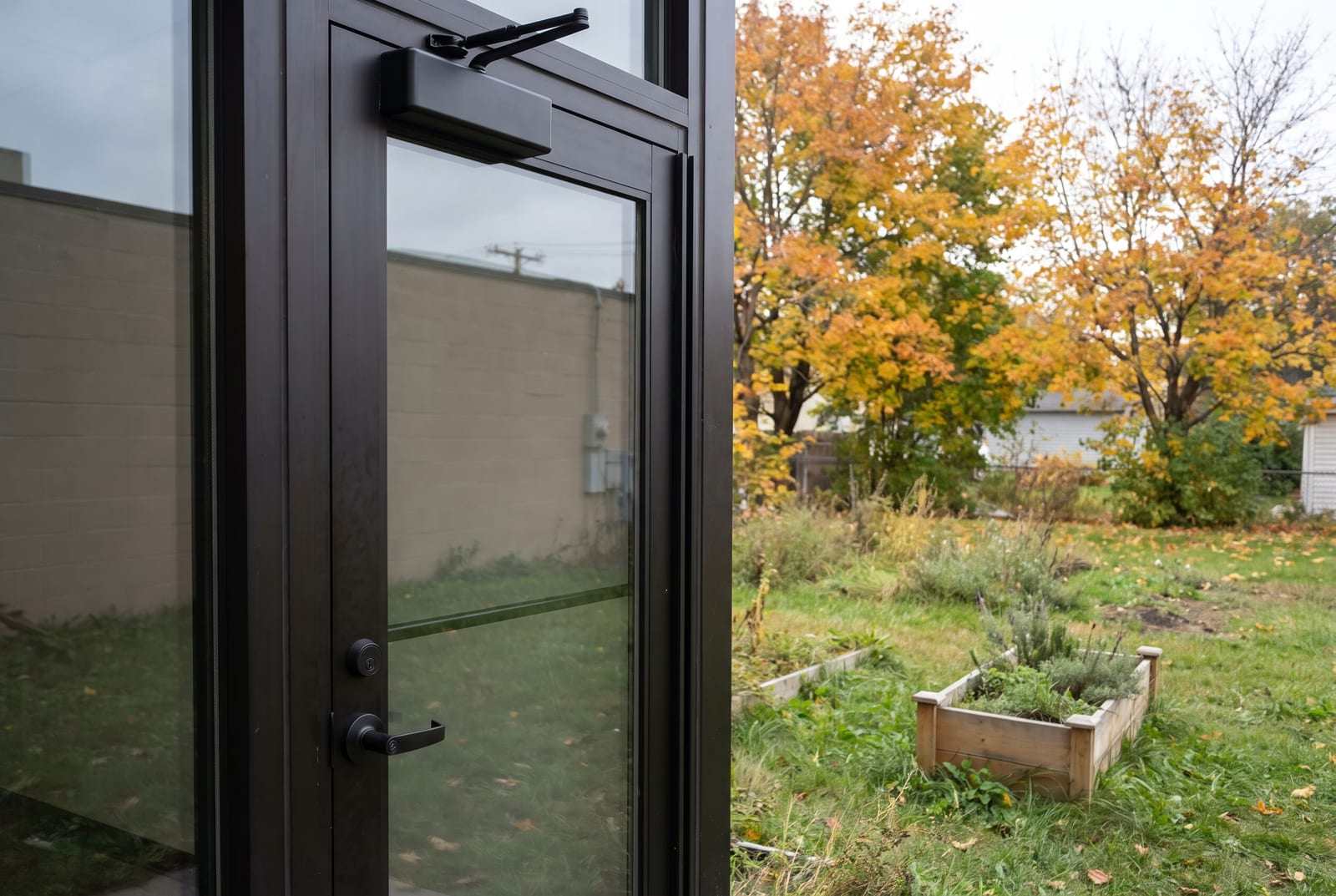
A business door works harder than a house door. It opens all day, more people carry its keys, and the building and fire codes have a say in how it locks. The work covers business lockouts, rekeying, worn or broken locks repaired or replaced, new deadbolts, key copies and master key systems for small buildings.
In the older brick buildings around Stevens Square, one address can hold a shop’s glass door, a back exit onto the alley and a hallway of apartment doors upstairs, each with rules of its own. Every job starts with a look at the door and a plan you agree to, as set out under Our Approach.
Commercial Door Hardware
Four things do most of the work on a business door. Each wears in its own way, and each relies on the others: a lock secures only a door that closes and latches.
| Hardware | Used on | Why it matters |
|---|---|---|
| Commercial deadbolt | Shop entrances, back doors and office suites; on narrow glass doors, a narrow-stile deadbolt with a hook bolt | A 1-inch bolt in a solid strike resists prying, and a heavy cylinder takes daily use without sticking. |
| Panic bar (exit device) | Exits where many people may leave at once, and back doors used as exits | Pushing the bar draws the latch in one motion, so the door opens from inside without a key. |
| Door closer | Entry doors, and fire-rated doors that must close on their own | A closer out of adjustment slams the door or stops it short of the latch, and an unlatched door is an unlocked one. |
| Master key system | Small office and apartment buildings, and shops with several doors | Each key opens only its own doors while one master opens them all, so fewer keys are in circulation. |
Signs Your Business Doors Need Attention
Commercial hardware seldom fails all at once. It wears, and the wear shows in how the door behaves long before the lock gives out. Worn hinges are often where it starts: the door sags, drags across the sill, and its latch drops out of line with the strike. Grit ground into an aluminum threshold and rust on a hinge plate are the early marks.
- A sticking latch. The latch bolt rubs the strike, or catches only when the door is pulled hard. Each time it fails to catch, the door stands unlocked, whatever the key says.
- A worn cylinder. Keys need jiggling or turn only part way. Pins, springs and keys wear together, and keys copied from copies make it worse; new pins and fresh keys usually cure it.
- Too many copied keys. Nobody can say who still holds a key to the back door. Rekeying makes every old key useless at once.
- An exit door that does not open freely. A bar that needs a shove, a lever that binds, or a bolt thrown at closing and forgotten. An exit that sticks is a safety problem before it is a lock problem.

Locks on Shop and Office Doors
Commercial levers come in two main builds. A cylindrical lock fits through a round bore like a house lock, only heavier, with stronger springs to hold the lever level. A mortise lock sits in a deep pocket in the door edge and holds the latch, often a deadbolt too, in one steel case, with the cylinder threaded into its face. It is built for heavy traffic and turns up in many older buildings.
The lock’s function decides who gets through. A storeroom function stays locked outside and always opens from inside, an office function locks with a button or a turn, and a classroom function locks from outside with a key.
A deadbolt over a lever adds a second bolt and a second motion to get out, a common upgrade on a door that is not a required exit. On one that is, the codes generally allow a single motion, so a mortise lock that withdraws both bolts with the inside lever, or an exit device, does the job instead.


Exit Doors and Panic Hardware
An exit door has one duty that outranks security: it opens from inside, every time, for anyone. Panic hardware, the push bar across the door, works that way by design. A rim device latches at the edge of the door, a vertical rod device latches into the frame head and the floor on a pair of doors, and a mortise device works a lock body set inside the door. The outside can still lock, with a cylinder or a trim that needs a key.
The usual faults are a latch that misses the strike on a sagging door, a rod that drags at the floor, and a bar dogged down (its latch held back with a key or a hex wrench) and forgotten, so the door never locks. A chain or a padlock added after a break-in is the worst of them: it turns a security worry into a fire risk. An exit door that will not release, or a business lockout, is a reason to call (612) 662-1116.
What makes an exit door code-compliant?
Under the building and fire codes Minnesota adopts, a required exit opens from inside with one motion, without a key, a tool or special knowledge. Its hardware sits where a hand expects it, between 34 and 48 inches off the floor, and nothing on the way out is chained, padlocked or bolted with a key. A door in a fire-rated wall also has to close and latch on its own, with hardware listed for fire doors. Which doors count as required exits is the local building or fire official’s decision.
Master Keys for Small Buildings
A master key system lets one key open many doors while every other key opens only its own. For a small building, two levels are usually enough: a change key for each unit or office, and a master for the owner or the manager. A third level, a submaster, opens one group of doors, such as a floor or the storage rooms, for a cleaner or a maintenance person.
Common doors are keyed by plan as well. The street entrance, the laundry and the mail room can take every tenant’s key, while each apartment takes only its own key and the master. The whole plan is written down as a keying chart: every door, every key and what each one opens.
There are trade-offs. Every extra pin that master keying adds is another way for a cylinder to turn, so a master-keyed lock is somewhat easier to pick than a plain one, and a lost master exposes every door it opens. A restricted keyway keeps the number of keys known: blanks come only from authorized dealers, and copies need the owner’s signature. A “do not duplicate” stamp on an ordinary key stops few copiers.
How does a master key system work?
Inside a pin tumbler cylinder, every pin stack has to line up at the shear line before the plug turns. In a master-keyed cylinder, small extra pins called master wafers split some of the stacks and create a second line-up: the change key lifts the pins to one, the master key lifts them to the other, and either one turns the plug. The keying chart records which change key fits which door and which master opens which group.
What happens to the keys when an employee leaves?
Ask for every key back and check them against the record of who received which. If a key is missing, or copies may exist, the locks that key opens get rekeyed and new keys go to the people who still need them. In a master key system a lost change key usually means rekeying one door, while a lost master can mean rekeying every door it opens, which is the reason to issue masters sparingly.
Locked Out of a Business
A business lockout tends to be one of three things: a key snapped in a storefront cylinder, a cylinder that will not turn, or keys left inside at closing. A snapped key can often be drawn out of the plug in one piece. A cylinder that has seized may have to be drilled to open the door and is replaced afterward; on a storefront door that means a mortise cylinder, threaded into the lock body and held by a set screw.
A locksmith opening a business asks for proof that you may enter: a lease or a utility bill in the business’s name, or a letter from the owner, with a photo ID. Planned work, such as rekeying after staff changes, a new deadbolt or a master key system, can start with a request through Schedule an Estimate.