
About Stevens Square Locksmith
A Minneapolis locksmith for houses, apartments, businesses and cars, owned by the locksmith who comes out to the job.
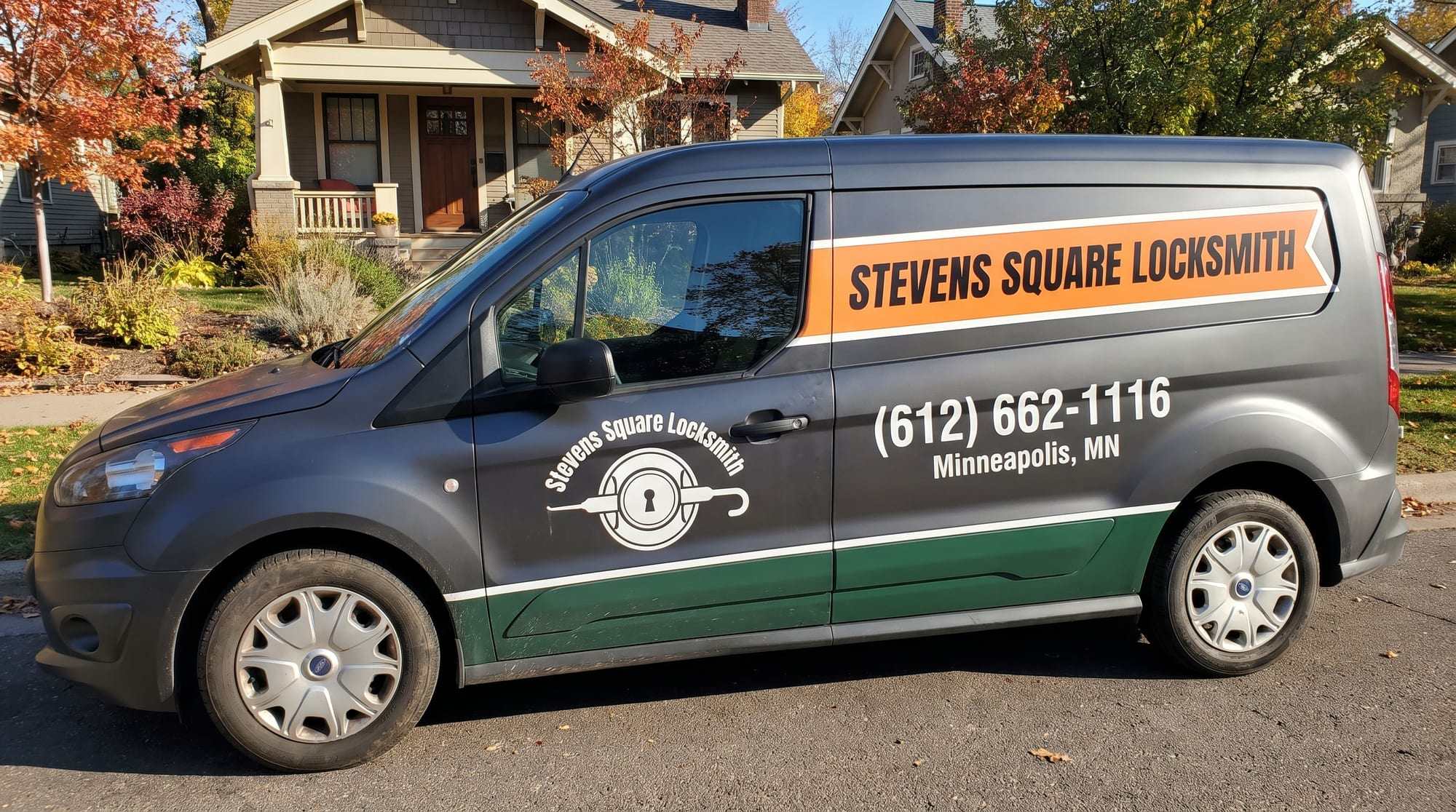
The company carries the name of the neighborhood where its work centers: Stevens Square, just south of downtown, a neighborhood of older brick apartment buildings. Its owner is Eric Allen.
Cutting Keys at a Hardware Store
Eric’s first job was at a hardware store, cutting keys. It is small, exact work: the original key is clamped in a duplicating machine beside a blank, a tracer follows the original’s cuts, and a cutting wheel copies them into the blank. He liked how quickly a small problem got solved that way.
A key is a row of cut depths along a blade, and every pin tumbler lock is built to read those depths, which is where key cutting leads into lock work.
In 2007 he started Stevens Square Locksmith. He wanted no one standing between him and the people whose doors he was fixing, and a company of his own was the way to have that.
More about Eric, including the locks he finds most interesting, is set out under Meet the Manager.
Stevens Square and the Wider City
From Stevens Square the work extends across Minneapolis, including Loring Park, Whittier, Elliot Park, Uptown, Powderhorn and downtown.
Between them, those neighborhoods hold a wide range of doors: street doors on closers with a buzzer panel beside them, apartment doors with a knob and a deadbolt, porch and back doors on older houses, glass storefronts in narrow aluminum frames, and office suites that share a master key. Older buildings tend to keep older hardware, mortise locks and rim cylinders among it, while newer ones run to cylindrical locksets and keypads.
The ZIP codes of those neighborhoods, and a check for your own, are under Where We Work.
House Doors, Shop Doors and Car Doors
The work covers the locks and keys of homes, businesses and cars, from a single copied key to every cylinder in a small building:
- Lockouts at houses, apartments and businesses. Many locked doors open by picking the cylinder or working the latch back. Drilling is the last resort, since it ruins the cylinder.
- Rekeying. New pins in the locks you already have, matched to a new key, so the old keys stop working.
- Lock repair and replacement. Worn or broken locks are repaired where the parts allow it, and replaced where they do not or where the door calls for a different lock.
- Deadbolt installation. A deadbolt where there was none: the door bored for the lock, and a strike fitted where the bolt meets the frame.
- Key duplication. Copies cut from a key you have, for a spare or for someone new in the household.
- Car keys, transponder keys included. A transponder key carries a chip that the car’s immobilizer has to recognize before the engine starts, so replacing one takes more than cutting the blade.
- Master key systems for small buildings. Each door has its own change key and one master opens them all, so the owner carries a single key while each tenant’s key opens only their own door.
If you are locked out right now, call (612) 662-1116.
What We Hold To
A few plain rules run through the work:
- You deal with the owner. The person who comes out to look at the door is the person who runs the company.
- The problem is looked over first. The lock, the door and what they are doing get a look before a tool is picked up.
- Work starts when you agree. You hear what is planned for the door, and nothing begins until you say yes.
How a visit runs, from the first questions on the phone onward, is set out under Our Approach.
The Van at the Curb
The company van is dark gray, with the name on an orange banner, the phone number on its side and a green band along the bottom.
When a locksmith arrives, the name and the number on the vehicle should match the ones you called. That is worth checking with any locksmith, and with this one it takes a glance at the van.
A rekey after a move, or a deadbolt for a back door that has none, can be requested through Schedule an Estimate with the address and what the lock is doing.